Gpt-5.5
GPT-5.5
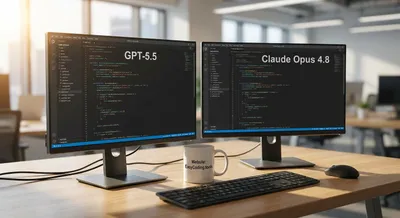
GPT-5.5 vs Claude Opus 4.8: Which Model Is Better for Agentic Coding Workflows?
Anthropic’s Claude Opus 4.8 is pitched as a “more effective collaborator” for coding projects. Anthropic’s previews note that 4.8 outperforms its own...
Gpt-5.5
GPT-5.5 is a name used for a next-generation large language model that builds on prior transformer-based models. It is designed to generate text, answer questions, write code, summarize information, and carry out conversational tasks with high fluency. Compared with earlier versions, models like GPT-5.5 typically include improvements in reasoning, context length, and the ability to follow complex instructions. They often support richer inputs and outputs, such as longer documents or multiple data types, which helps them handle more realistic workflows. Developers and companies use these models through APIs or integrations to automate writing, coding, customer support, and research tasks. The model’s performance can speed up everyday work and open new possibilities for creativity and problem solving. At the same time, using such powerful models raises important questions about accuracy, bias, privacy, and misuse, so teams need to add checks like verification steps, safety filters, and human oversight for critical tasks. Because these models require significant compute and data, they also affect costs and environmental footprint for organizations that deploy them. Overall, GPT-5.5 represents a step forward in how machines can assist with complex language and coding problems, and it matters because it changes how work gets done and what kinds of tasks can be automated.
Get New AI Coding Research & Podcast Episodes
Subscribe to receive new research updates and podcast episodes about AI coding tools, AI app builders, no-code tools, vibe coding, and building online products with AI.